Passivation
Restore corrosion resistance. Improve hygiene. Extend equipment life.
Professional on-site and in-house stainless steel passivation services for food, dairy, pharmaceutical, and clean industrial systems—performed to recognized industry standards.
Corrosion Resistance
Restores the passive layer to reduce rusting and surface breakdown.
Hygienic Surfaces
Supports cleanable, sanitary surfaces for regulated applications.
Long-Term Performance
Improves durability and extends equipment service life in harsh environments.
Share your scope, photos, or drawings — we’ll recommend the best method and provide a clear quote.
Passivation and Our Process
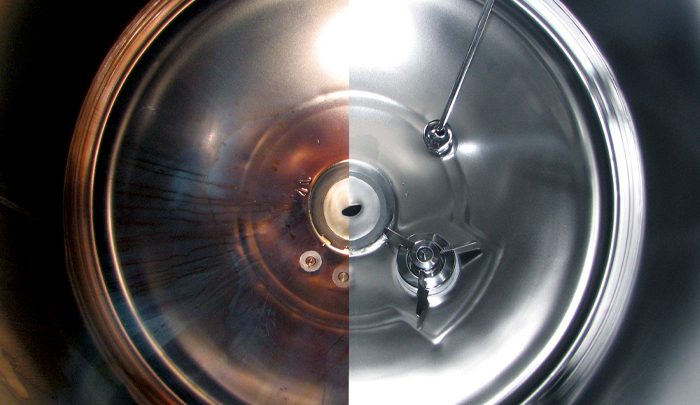
Passivation is a controlled chemical treatment that removes free iron and surface contamination from stainless steel, allowing the natural chromium oxide passive layer to fully form.
This layer is essential for:
- Corrosion resistance
- Hygienic, cleanable surfaces
- Long-term equipment performance
The Process
-
Surface Preparation & Degreasing
All stainless-steel surfaces are first thoroughly cleaned and degreased to remove oils, shop residues, fabrication contaminants, and handling debris. Cleaning methods are selected based on surface condition and application (spray, wipe-down, or circulation).- Removes organic contamination
- Prepares surface for chemical treatment
- Verified using visual checks and water-break testing
-
Oxide & Weld Treatment (When required)
Where welding, heat tint, or oxide scale is present, affected areas are treated using controlled descaling or pickling methods prior to passivation. This step removes chromium-depleted layers created during welding or heat exposure and ensures a uniform, corrosion-resistant surface can be restored.- Applied only where needed
- Prevents localized corrosion risks
- Followed by thorough rinsing
-
Chemical Passivation
Passivation is performed using a controlled chemical process to remove free and embedded iron and promote formation of a stable chromium oxide passive layer. Chemistry, concentration, temperature, and contact time are matched to stainless steel grade (304 / 316 / 316L), industry requirements, and client specifications.- Restores corrosion resistance
- Improves hygienic performance
- Extends equipment service life
-
Rinsing, Neutralization & Drying
After passivation, all surfaces are rinsed until near-neutral conditions are achieved. Spent solutions are neutralized and handled in accordance with environmental and regulatory requirements. Equipment is then dried using clean methods to prevent recontamination and allow the passive layer to stabilize.- Neutral pH verification
- Proper waste handling
- Controlled drying
-
Inspection & Verification
Final inspection verifies passivation effectiveness. Where specified, recognized acceptance tests confirm removal of iron contamination and surface cleanliness. Documentation can be provided upon request.- Visual inspection
- Industry-recognized test methods
- Documentation available
Where It’s Applied
- New fabrication
- Post-welding or grinding
- After polishing
- During shutdowns & turnarounds
- Corrosion remediation
What We Passivate
Fortis Industrial Solutions provides chemical passivation services to restore the protective chromium oxide layer on stainless steel surfaces after fabrication, welding, polishing, or repair. Our services support hygienic operation, corrosion resistance, and long-term equipment performance in demanding sanitary environments.
- Process & storage tanks
- Skid-mounted systems & modules
- Sanitary piping & tubing
- CIP systems & flow panels
- Weld repairs & field modifications
- Polished or mechanically finished surfaces
Our Passivation Chemistry Comparison
| Parameter | Citric Acid Passivation | Nitric Acid Passivation |
|---|---|---|
| Typical Applications | Food, dairy, beverage, pharmaceutical, hygienic systems | Industrial systems, legacy specifications, aggressive environments |
| Purpose | Removal of free iron and restoration of passive layer | Removal of free iron and restoration of passive layer |
| Effectiveness | Highly effective when properly applied | Highly effective when properly applied |
| Industry Acceptance | Widely accepted in sanitary industries | Long-established industry standard |
| Corrosion Resistance | Excellent | Excellent |
| Impact on Surface Finish | Minimal | Minimal |
| Odour / Fumes | Low | Possible NOx fumes |
| Environmental Profile | More environmentally friendly | Strong oxidizer – higher controls required |
| Worker Safety Profile | Lower relative hazard | Higher hazard – strict safety controls required |
| Typical Use Drivers | Hygiene, environmental preference, food safety | Client specification, historical or technical requirements |
| Standards Alignment | ASTM A967 / ASTM A380 | ASTM A967 / ASTM A380 |
Chemistry selection depends on project requirements, stainless grade, scope, and customer specifications.
Passivation Methods We Use
Fortis Industrial Solutions applies stainless steel passivation using controlled application methods selected based on equipment size, geometry, accessibility, and project requirements. Each method is designed to ensure effective removal of free iron and restoration of the protective passive layer on stainless steel surfaces.
Circulation / CIP Passivation
- Best suited for: Tanks, skidded systems, process piping loops, CIP circuits
- Description: Controlled loop circulation for uniform internal coverage
- Why it’s used: Consistent treatment, ideal for internally wetted equipment, minimal manual intervention
Spray Application
- Best suited for: Large vessels, external surfaces, fixed equipment
- Description: Controlled spray contact followed by thorough rinsing
- Why it’s used: Effective for installed equipment, flexible on-site, common during shutdowns
Immersion Passivation
- Best suited for: Spools, small components, fabricated parts
- Description: Full submersion in a controlled passivation bath
- Why it’s used: Uniform, repeatable results, controlled processing conditions
Localized / Spot Passivation
- Best suited for: Weld repairs, localized contamination, field touch-ups
- Description: Targeted treatment without full-system processing
- Why it’s used: Minimal disruption, effective for repairs and small affected areas
Methods may be combined on complex scopes to meet access, safety, and acceptance requirements.
Why Choose Fortis Industrial Solutions
Combined with our engineering-backed procedures, Fortis Industrial Solutions’ equipment and field capabilities allow us to deliver high-quality passivation services—even in complex or constrained environments.
Equipment & Field Capabilities
Purpose-Built Passivation Equipment
- Pneumatic diaphragm pumps suitable for passivation chemicals
- Chemical-resistant hoses, spray systems, and circulation loops
- Mobile pump carts configured for on-site operations
- Controlled application for spray, circulation, immersion, and localized treatments
Mobile Pump Carts & On-Site Setups
- On-site circulation (CIP-style) passivation
- Spray application on fixed or large equipment
- Flexible connection to tanks, skids, and piping systems
Working at Heights & Confined Space Awareness
- Elevated tanks and platforms
- Vessel interiors
- Restricted access areas
Engineered for Reliability & Safety
- Controlled chemical handling
- Consistent surface treatment
- Reduced risk during application and rinsing
- Compliance with site safety expectations
Our focus is delivering reliable passivation outcomes while maintaining safe, organized, and professional field execution.
Ready to Start Your Project?
Tell us what you need — we’ll confirm scope and provide a clear quote.