Stainless steel passivation is a controlled chemical treatment used to remove free iron and surface contamination and support the formation of the natural chromium oxide passive layer.
This treatment is particularly useful after stainless steel fabrication, welding, grinding, polishing or repair where the surface may have been exposed to contamination or fabrication residues.
Fortis Industrial Solutions provides passivation services for stainless steel process equipment, sanitary systems, piping, tanks, skids and fabricated components.
Passivation helps restore a clean, corrosion-resistant stainless steel surface suitable for demanding industrial and sanitary applications.
A properly selected and controlled passivation treatment helps improve the surface condition and performance of stainless steel after fabrication and processing.
Supports restoration of the stainless steel passive layer and helps reduce the risk of surface corrosion caused by free iron and contamination.
Supports cleanable stainless steel surfaces for sanitary process systems and applications where cleanliness is important.
Proper surface treatment supports stainless steel equipment performance and durability in demanding industrial environments.
Stainless steel surfaces can be exposed to free iron, fabrication residues and welding-related surface conditions during manufacturing and installation.
Stainless steel surfaces are cleaned and degreased before chemical treatment to remove oils, shop residues, fabrication contaminants and handling debris.
Where required, welding heat tint, oxide scale and affected surface areas are treated using controlled descaling or pickling methods before passivation.
A controlled chemical passivation treatment is applied to remove free and embedded iron and support the formation of a stable chromium oxide passive layer.
Treatment chemistry can be selected according to the application, stainless steel surface condition and project requirements.
Citric acid passivation is used for removal of free iron and restoration of the passive layer and can be suitable for food, dairy, beverage, pharmaceutical and hygienic systems.
Nitric acid passivation may be selected for industrial systems and applications according to the applicable project specification and treatment requirements.
Controlled circulation can be used for tanks, skidded systems, process piping loops and CIP circuits requiring internal surface treatment.
Controlled spray application can be used for large vessels, fixed equipment and external stainless steel surfaces.
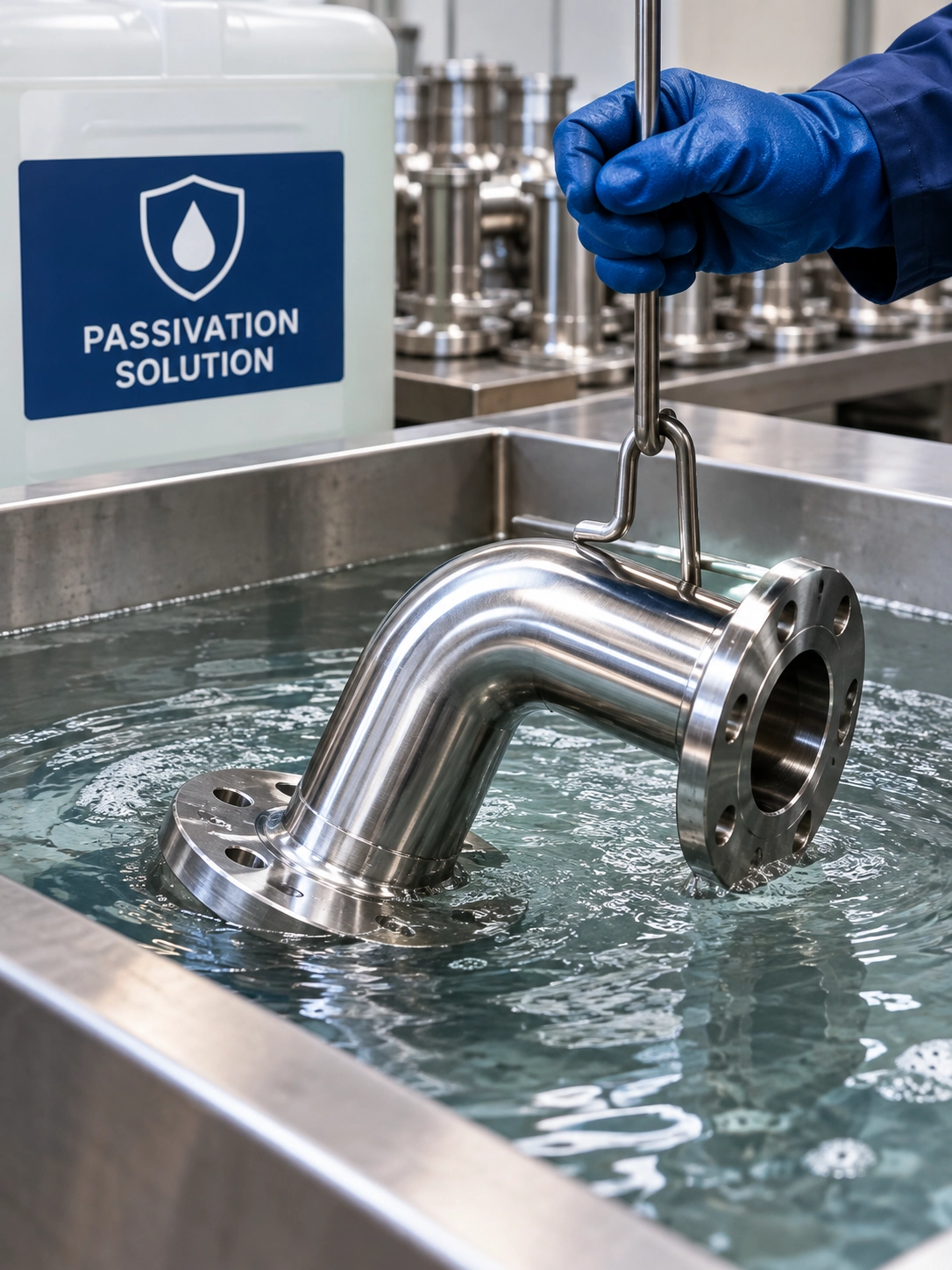
Small components, fabricated parts and spools can be treated through controlled immersion where suitable.
Localized treatment can be considered for weld repairs, contamination areas and field touch-up requirements.
Passivation for stainless steel tanks and process equipment following fabrication, welding or surface treatment.
Surface treatment for stainless steel skids, modules and integrated process systems.
Passivation for sanitary stainless steel piping, tubing and process flow systems.
Treatment for CIP circuits, flow panels and internally wetted stainless steel systems.
Localized treatment for stainless steel weld repairs and field modifications where required.
Passivation can be applied to suitable polished or mechanically finished stainless steel surfaces after appropriate cleaning.
Stainless steel passivation is a controlled chemical treatment used to remove free iron and surface contamination and support the formation of the natural chromium oxide passive layer on stainless steel.
Passivation may be considered after stainless steel fabrication, welding, grinding, polishing, repair or other processes that can introduce free iron or surface contamination.
Pickling and passivation are related but different treatments. Pickling is generally used to remove oxide scale, weld heat tint and affected surface layers, while passivation focuses on removing free iron and supporting restoration of the passive chromium oxide layer.
Yes. Stainless steel piping and tubing can be treated using an appropriate passivation method. Circulation or CIP-style treatment can be considered for suitable process piping loops and internally wetted systems.
Useful information includes stainless steel grade, component or equipment type, dimensions, surface condition, weld areas, photographs, drawings and the intended application or required treatment scope.
Share your equipment details, drawings, photographs, stainless steel grade or treatment requirement with Fortis Industrial Solutions. We can review the scope and recommend a suitable passivation approach.
